
Records That Shape a Derby Resident Lookup
There is no official master list of Derby residents. A resident lookup instead moves among sources that answer different questions. VoterView can test a registration query when the required identity fields are known. Kansas CaseSearch can surface a docket lead. Vital Statistics handles eligible certificate requests, while state entity and license portals verify a public filing or credential. None of those results should be relabeled as a general residency finding.
| Source record | Question it can answer | Official route | Access boundary |
|---|---|---|---|
| Voter registration lookup | Whether supplied identity details return a current registration result | Kansas VoterView | First name, last name, and date of birth required |
| Court docket | Whether a named party or case number appears in covered court data | Kansas CaseSearch or the responsible clerk | Public portal is discovery, not the official record |
| Vital certificate | A qualifying birth, death, marriage, or divorce event | KDHE Office of Vital Statistics | Eligibility, ID, relationship, and fee rules apply |
| Entity or license file | A registered business or regulated credential | Kansas SOS or state license portal | Search fields and status vary by agency |
| Historical directory | A dated association with a postal place, township, school, or address | Derby Library, MHGS, WPL, or KSHS | Historical lead only, with year and page |
Begin with the record implied by the clue. A case number belongs with the court, a licensed trade with its board, and a historical classmate with yearbooks or newspapers. If the only clue is a name, pause and seek a year, place, or relationship before searching. That step cuts down false matches and protects unrelated people.
VoterView Gives a Narrow Derby Resident Check
Kansas VoterView's registration mode requires First Name, Last Name, and Date of Birth. Its date control displays year-month-day while the request format is month/day/year, and the interface may use reCAPTCHA. A match can show registration or address information, party association, mail-in-ballot status, and polling location. The separate polling-place mode takes a residential location through address autocomplete.
| Registration inputs | First Name, Last Name, Date of Birth, and Look Up |
|---|---|
| Possible match details | Registration or address information, party association, ballot status, and polling location |
| Polling-place mode | Residential location with address autocomplete and View Locations |
| Result label | Voter lookup observed on the search date, not permanent proof of residence |
Do not guess a birth date to force a match. If the inputs are not known, say the official check could not be completed. Sedgwick County Elections also provides supervised inspection and defined data-request routes under K.S.A. 25-2320, while protected identifiers are removed and use restrictions apply.
Match a Derby Court Question to the Right Portal
Derby Municipal Court covers city ordinance, traffic, fire-code, property, and other misdemeanor matters. Its page offers payment and warrant links, but no public name-search case database. A request should go to the clerk with a citation, case number, date, or record type. The clerk is at 229 N Baltimore and can be reached at 316-788-1511 or derbymunicipalcourt@derbyks.gov.
Kansas CaseSearch is the statewide discovery route. Its interface includes court, Search Type, Search Term, Case Type, date of birth, file-date range, reCAPTCHA, and terms acceptance. Basic details can be available to guests, but the portal says it is not the official court record. The 18th Judicial District is the custodian route for district civil, criminal, marriage and divorce, wills and probate, and support records.
The 18th Judicial District records page shown below leads to the public terminal, written request instructions, exclusions, and copy routes.
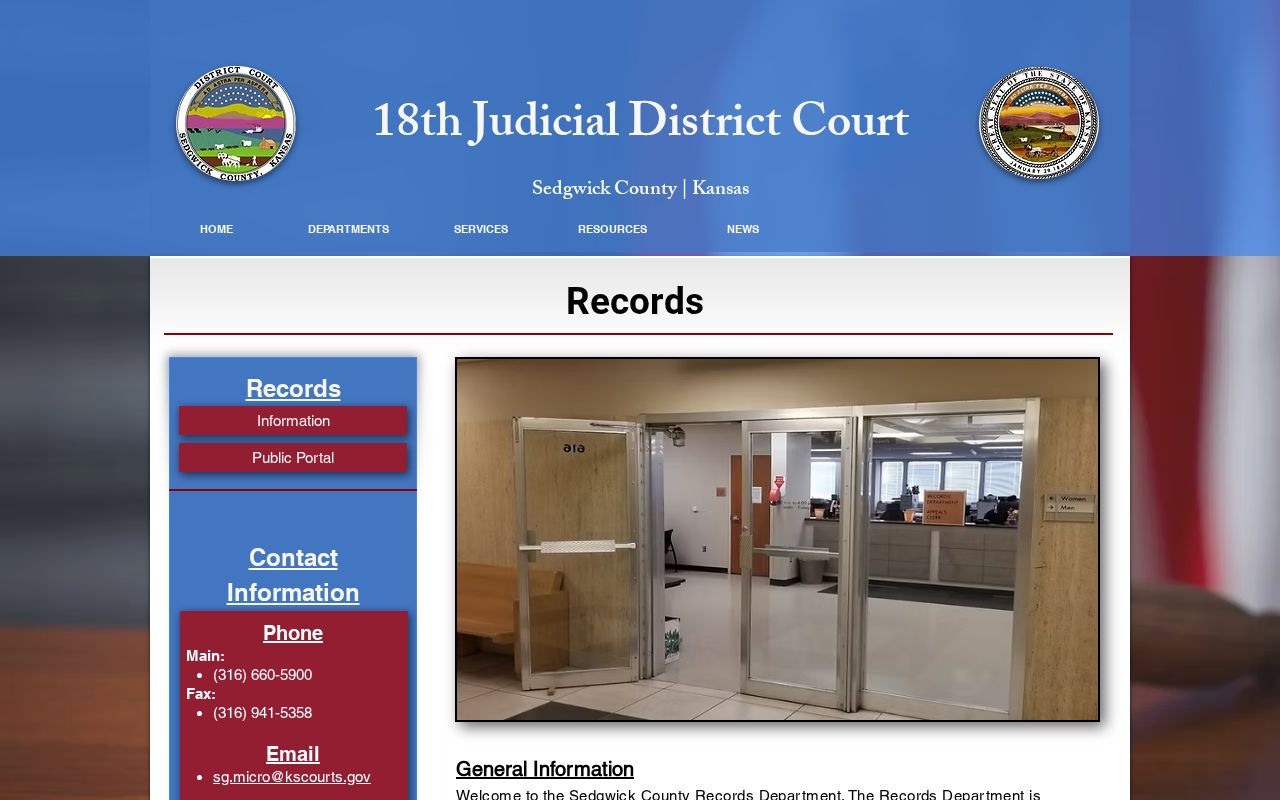
The image confirms the office context, while an actual docket must still be tied to its case number, court, status, and retrieval date.
Verify a Derby Resident With Two Anchors
The safest Derby resident lookup preserves each source's role. A court hit is a docket lead, a voter result is a dated lookup, and a historical directory line is dated evidence. Choose one known anchor, confirm it through a second independent source, and stop if the records conflict rather than smoothing over the mismatch.
- Write the exact name and one reliable date, address, parcel, case number, organization, or family link.
- Select the official source whose coverage fits the question and save the search date and inputs.
- Record the result as an index, docket, filing, certificate route, or historical entry, not as a broad identity claim.
- Compare a second independent anchor, such as a matching case number, dated directory page, deed party, or documented event.
- Request the official or certified copy from the custodian when the purpose requires more than portal discovery.
- Docket
- The court's chronological case activity list, which may show filings, hearings, events, and status without supplying every document.
- Index versus image
- An index points to a record through selected fields; an image reproduces the filed or issued document itself.
- Certified copy
- A custodian-issued reproduction bearing formal certification, subject to that office's access and fee rules.
Kansas Vital Records Set a Firm Derby Lookup Boundary
KDHE's Office of Vital Statistics holds Kansas birth, stillbirth, death, marriage, and divorce records, but these are not open name indexes. Copies go through eligibility, relationship, identification, and documentation rules. Standard certified copies are listed at $20. The genealogy route says state birth and death records begin July 1, 1911, marriage records May 1, 1913, and divorce records July 1, 1951.
For a Derby family-history question, first establish an event date and county through a directory, newspaper, census, or family source. Then decide whether OVS coverage applies. Older county ledgers, church records, cemetery sources, FamilySearch, KSHS, or MHGS may supply a historical index. The 18th District provides a full divorce decree, while OVS supplies the certificate. Ordinary open-record requests do not override vital-record confidentiality.
Confirm Derby Business and License Connections Separately
A person may appear as part of a business entity or regulated credential, but that record answers a business or license question rather than a residency question. The Kansas Secretary of State Business Entity Search accepts business name, business ID, resident-agent name, and keyword. Results can show the entity name, ID, status, resident agent, registered office, mailing address, formation date, and report history.
Kansas professional verification searches by profession, license type, first name, last name, or license number. The official detail may show credential number, profession, type, original issue, expiration, status, and disciplinary action. Verify a Chamber listing through the Secretary of State or the controlling board, and preserve the local directory entry only as community context.
The Same-Name Trap in a Derby Resident Lookup
A name in a court, voter, directory, parcel, or license result is not automatically the same person. This is especially important when a short name or initials recur. Kansas systems have different coverage, update schedules, and warnings. Even a correct portal result may describe a former address, a filing role, an owner mailing field, or a historic post-office association.
Identity check. Require two independent anchors and keep the exact observation date for every dynamic portal result.
Negative findings need the same care. A missing birth date can block VoterView, sealed categories can be absent from court search, and a dynamic portal may fail. Report the gap. Do not replace it with a broad commercial name match or infer that the person or record does not exist.
Look Up a Past Derby Resident Through Local Collections
Historical names belong in dated sources. Derby Public Library has local newspapers on microfilm, school yearbooks, databases, and the Derby History Archive. MHGS provides county and city directory material, including the 1902 county volume. Its Derby entries can pair a Derby post-office label with Rockford, Salem, or Gypsum township, so modern address assumptions are risky.
Record the publication, year, page, and geography, then compare census, deed, newspaper, yearbook, or cemetery evidence. The Derby city directory guide explains those shelves and entry forms in depth. Keep that historic trail distinct from a current resident lookup.
When Derby Resident Records Need a Custodian Request
Some public records are not indexed online. The City Clerk handles defined city records, while municipal court requests go directly to the court. The 18th District accepts one written request per case number by email, mail, fax, or in person. Derby's open-record guidance calls for a response, delay, or denial within three business days, and fees may reflect actual costs.
A useful request names an existing record, responsible department, date range, case or citation number, and preferred format. Avoid asking for every record about a person. Kansas Open Records Act procedures do not erase exemptions for protected, sealed, medical, investigative, vital, or other confidential material. If a custodian explains that a record is withheld or held elsewhere, preserve that reply as part of the search trail.
Privacy Limits for a Derby Resident Lookup
Kansas Safe at Home provides a substitute-address and mail-forwarding program for eligible survivors and household members. Public portals and copies may also omit protected addresses, identification numbers, sealed cases, juvenile matters, and other confidential fields. Do not attempt to reconstruct a location that a custodian or protection program has withheld.
Lawful use. Use a Derby resident lookup only for lawful personal research. Never use records to stalk, harass, intimidate, or expose a protected person.
Correction starts with the source. A court item goes to the clerk, voter data to Sedgwick Elections, a vital certificate to OVS, and a business or license status to the responsible state office. Keep screenshots and observation dates, explain any uncertainty, and replace stale notes when the custodian supplies an updated record.