
Derby City Directory Shelves and Digital Runs
Derby does not have one seamless annual run under a single title. Its historical directory trail is spread among county compilations, Wichita and Sedgwick County books, telephone volumes, and reverse-address editions. The Midwestern Historical and Genealogical Society directory guide is the clearest collection map. It should be read beside Derby Public Library holdings and Wichita Public Library's regional collection, since each place offers a different slice of the record.
| Directory family | Years described | Research home | How to consult it |
|---|---|---|---|
| Wichita printed directory run | 1800s through 2006 | MHGS and Wichita Public Library | Catalog, shelves, scans, and local-history room |
| Sedgwick County suburban directories | 1957 through 1995 | MHGS regional collection | Check the catalog and ask about on-site use |
| Telephone and criss-cross books | 1930s to present | MHGS and Wichita Public Library | Primarily in-person collection research |
| Digitized Wichita and county volumes | Selected 1877 through 1904-05 volumes, plus 1881 Gazetteer | MHGS online directory collection | Free PDF or transcription where posted |
The year ranges describe source families, not a promise that every year includes Derby or survives on a shelf. A Wichita book may list Derby only as a suburban, postal, or county place. Before citing a result, note the exact title, year, page, and place label. That small habit prevents a broad collection range from becoming a false claim of complete coverage.
Derby City Directory Research Starts at the Local Library
Derby Public Library is the most local doorway into this work. Its local-history collection includes Derby newspapers on microfilm, Derby High School and Derby Middle School yearbooks, Kansas reference works, and a small Derby-area history shelf. Two computers can read microfilm and microfiche. The library also offers in-library Ancestry Library access, plus Fold3, NewsBank, and AtoZ, and it serves as a FamilySearch affiliate.
The library can seek microfilm from the Kansas Historical Society and other sources, sometimes for a nominal charge. Staff can also help frame a query when the known clue is a school, surname, street, or event rather than a book title. The library is at 1600 E Walnut Grove, and its listed phone is 316-788-0760. A focused call before a visit can establish whether the useful item is on a shelf, on film, in a database, or held elsewhere.
Regional City Directories Bring Derby Into View
The Edward and Elizabeth Burns Historical Research Pavilion at Wichita's Advanced Learning Library supplies the regional layer. Its holdings include city directories, telephone books, maps, atlases, photographs, and Sanborn maps on microfilm. The Wichita genealogy collection adds census and Soundex film, family histories, and land, tax, probate, cemetery, church, and vital-record indexes. These sources matter because Derby may be cataloged as a suburb, county post office, township-linked place, or nearby community.
The Wichita Public Library digital collection offers remote discovery through digitized maps, photographs, books, and other local-history items. A search result there is a lead, while the Pavilion remains the route for unique or undigitized items. Keep the repository and format in the citation so a scan, microfilm image, and printed volume do not blur into one source.
How to Read a Derby City Directory Entry
A directory entry must be read according to its own volume. The 1902 Sedgwick County book says it contains county residents' names, post-office addresses, and townships. Its Derby lines therefore do not follow the richer name, spouse, work, and numbered-address pattern that may appear in a later city directory. Photograph or save the title page and abbreviation key before interpreting any short form.
| Personal name | Record initials, spelling, and nearby same-surname entries exactly as printed. |
|---|---|
| Post-office label | In the 1902 county volume, Derby identifies the post-office place rather than a modern street address. |
| Township | Rockford, Salem, or Gypsum can appear beside a Derby label and must remain a separate field. |
| Work or spouse detail | Later volumes may include these fields, but only cite them when that edition prints them. |
| Street or house mark | Read symbols through the edition's key; do not assume one publisher's shorthand applies to another. |
- Criss-cross directory
- A reverse section arranged by street and number, useful when an address is known but the surname is not.
- Householder index
- A name-based list of household heads or listed occupants, shaped by the publisher's collection rules.
- Abbreviation key
- The volume's guide to its own symbols and shortened terms, often essential for reading an entry correctly.
The 1902 Derby Directory Has a Geography Surprise
The digitized 1902 county volume gives an unusually clear lesson in historical place labels. Entries such as Alread Elza, Austin Earl, and Austin Sam pair Derby with Rockford. Other lines pair Derby with Salem or Gypsum. The city directory evidence is valuable, but it records postal and township geography that does not map neatly onto a present city boundary.
Research note. Preserve Derby, the township label, volume year, and page as separate facts before joining the entry to another record.
This is also why spelling variants and nearby family groups deserve attention. A repeated surname in adjacent lines may suggest a lead, yet it does not prove a household tie. Test it against census, deed, newspaper, cemetery, or vital-record material from the same period.
Before Derby, Search the City Directory Trail for El Paso
Derby began as El Paso. The railroad and depot story pushed use of Derby during the 1880 era, but the city did not formally change its name until 1956. The 1877 Wichita directory's distance table lists El Paso southeast of the city. That chronology makes the old name a search key, not mere local color.
For an older family or place, search both names and then confirm the match with a township, plat, legal description, newspaper item, or other dated anchor. A city directory hit under El Paso may belong to the same community story, but the source itself must establish the connection.
Derby's Community Archive Adds Faces to Directory Names
The Derby History Archive grew from the city's 2019 sesquicentennial. Derby Public Library and the Derby Informer asked residents for photographs and documents, scanned hundreds of items, and continued adding material. It gives a directory researcher a chance to connect a terse name or place line with a school image, news clipping, civic document, or community photograph.
That archive is not a current roster, and an image caption is not automatic proof of identity. Use names, dates, event labels, and source notes as clues. Then compare them with the yearbooks, newspapers, and volumes held by the library. This careful chain preserves the human story without asking one archival item to prove more than it says.
Tracing a Derby Family Across Directory Years
A strong family-history search treats each Derby city directory as one dated frame. Begin with the best-supported year, copy the entry as printed, and then move in both directions through the available books. Census years, deeds, yearbooks, newspapers, and cemetery sources can test the intervals and explain a move or disappearance.
- Start with a full name, likely year, and known Derby, El Paso, township, school, or street clue.
- Record the volume title, year, page, spelling, address form, post office, and township exactly.
- Check earlier and later volumes, including suburban and criss-cross books, without assuming every year survives.
- Pair the trail with census records, deeds, parcel history, yearbooks, newspapers, and maps from the same era.
- Use an obituary, cemetery record, probate file, or later directory only when it independently fits the identity.
A missing entry has several possible causes: the person moved, died, changed names, went unlisted, fell outside that edition's coverage, or appeared under another place label. It is not proof of absence. For a modern address-based task, use the separate Derby street directory guide rather than forcing a historical volume to answer a current question.
Maps and Yearbooks Complete the Derby City Directory Picture
The MHGS house-history guide recommends checking alphabetical and reverse directories alongside census records, deeds, appraiser files, newspapers, photographs, maps, atlases, and aerial images. Derby school yearbooks at the local library add a useful classmate and activity layer. Wichita Public Library and Wichita State Special Collections add maps, photographs, newspapers, and local-history notes.
Sanborn maps can show detailed parcels, streets, water lines, and hydrants for covered towns and years. Kansas coverage spans 1883 through 1954, with some revisions as late as 1968, but the reviewed official indexes did not settle whether a Derby edition exists. Ask KSHS or Wichita Public Library to check the city list and microfilm rolls. Do not turn an unsuccessful online search into a claim that no map was made.
What a Derby City Directory Can and Cannot Prove
City directories are time capsules. Depending on the edition, an entry may show a name, postal place, occupation, spouse, business, household, or address. It does not prove that the person still lives there, owned the place, or is the same individual found in a modern portal. Even two matching names can refer to different people.
The sound citation keeps the directory title, publisher or form, year, page, entry text, repository, and access date together. Note whether the item was a printed book, PDF, transcription, or microfilm image. When a directory clue needs present-day verification, shift to the record-specific workflow on the Derby resident lookup page and keep the historical and current evidence in separate blocks.
Derby City Files Can Resolve a Directory Puzzle
When a street name, subdivision, or civic detail shifts between years, Derby's permanent municipal files can supply context. The city retention schedule identifies plats, surveys, subdivision files, street-name files, and historic-structure material. The Derby City Clerk page identifies the records office that can route a focused request.
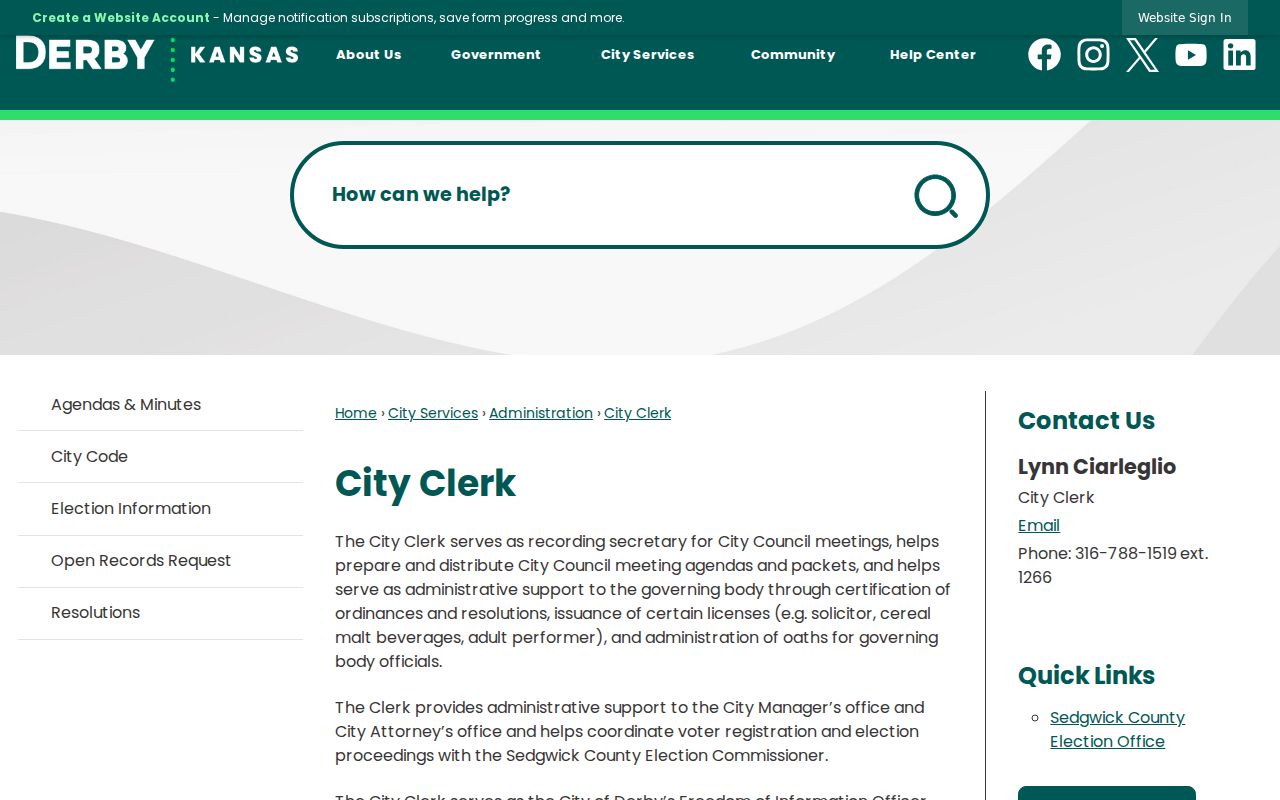
The official page shown above is a request doorway, not a historical name index. Ask for an existing, well-defined file by record type, date range, street, subdivision, or resolution, and keep the reply separate from the printed directory citation.