
Derby Previous Residents by Era
Different Derby sources cover different parts of an address history. Deeds establish recorded interests, parcel files supply the present research key, and directories can place a named household at an address in a dated volume. None is a complete list of previous residents by itself.
| Source | Years It Covers | Where Held | What It Shows |
|---|---|---|---|
| Deed index | Deeds from 1945; other records from 1969 | Sedgwick Register of Deeds | Parties, date, document number, legal description |
| Index books and deed books | Before online coverage; first county deed in 1870 | Register of Deeds | Earlier transfers and recorded instruments |
| Historical transfer books | Pre-1992 transfer route | Sedgwick County Clerk | Transfer chronology to reconcile with deeds |
| Criss-cross directories | 1930s to present | MHGS and regional libraries | Dated address-to-name evidence |
| County/suburban directories | 1957 to 1995 | MHGS and local-history collections | Derby-area households and place labels |
| Maps, newspapers, yearbooks | Varies by collection | Derby and Wichita libraries, KSHS | Street form, buildings, events, and household context |
Begin with the current parcel even when the goal is historical. Its PIN and legal description offer a more stable bridge than the street number. For mid-century occupants, a suburban or criss-cross directory may be the quickest second source. For an earlier period, plan on index books, maps, newspapers, and archive help.
Anchor Derby History to a Parcel
Search My Local Taxes by address, select the parcel, and copy the PIN, situs address, mailing address, legal description, and current deed reference if shown. Situs means the physical site. The mailing address is where notices go and may be outside Derby.
Next, confirm the parcel in Mobile Land Records. County GIS accepts an address, PIN, or street intersection and warns that its tax parcel lines are not a survey. Save the map date and source URL. If the legal description has changed through a split, combination, or replat, trace each version rather than forcing them into one chain.
Note: A current owner name is a deed lead, not proof that the person occupies the Derby address.
Walk Sedgwick Deeds Backward
The Sedgwick County deed search is the recorded-owner spine for Derby previous residents research. A chain of title is the sequence of recorded transfers tied to the same land. Search the present instrument first, then move backward while checking that the legal description still matches.
- Copy the current PIN, legal description, deed number, and grantee from the parcel and deed image.
- Search the current grantor as a grantee to locate that party's earlier acquisition.
- Compare lot, block, subdivision, acreage, or section-township-range at every link.
- Repeat until the online coverage ends or the land description no longer matches.
- Use public computers, index books, historical transfer books, microfilm, and staff help for the gap.
- Grantor and grantee
- The grantor gives an interest; the grantee receives it.
- Chain of title
- The linked sequence of recorded transfers for the same land.
- Legal description
- The lot, block, subdivision, or land description that identifies property more precisely than a street address.
The deed-specific online lead begins in 1945, while the office FAQ says general post-1969 records are online and older searches use index books. Verify any pre-1969 image or gap with the office. The first Sedgwick County deed, recorded September 20, 1870, sets county chronology but proves nothing about a particular Derby parcel.
Derby Deed Access Beyond One Portal
Tapestry EON launched in February 2025 and supports grantor, grantee, date-range, and legal-description searches. The documented price is $8.75 for an index and image search plus $1 per page. Laredo serves subscription users. Free public computers at the Wichita office provide another channel, and copies there are $1 per page.
Review the county's land search choices with the captured page below.
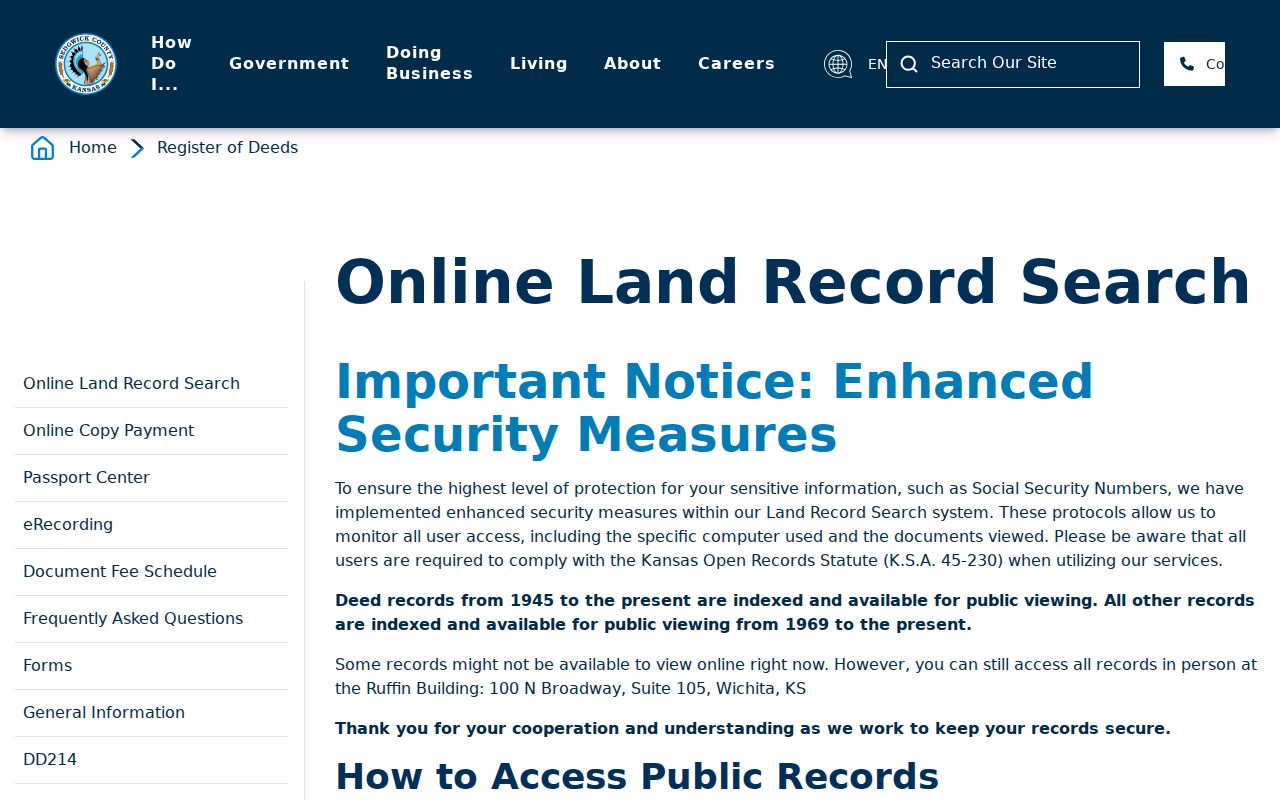
The office, books, and written-copy route remain essential when a Derby deed is absent online.
Open the Tapestry EON details before using the captured service screen.
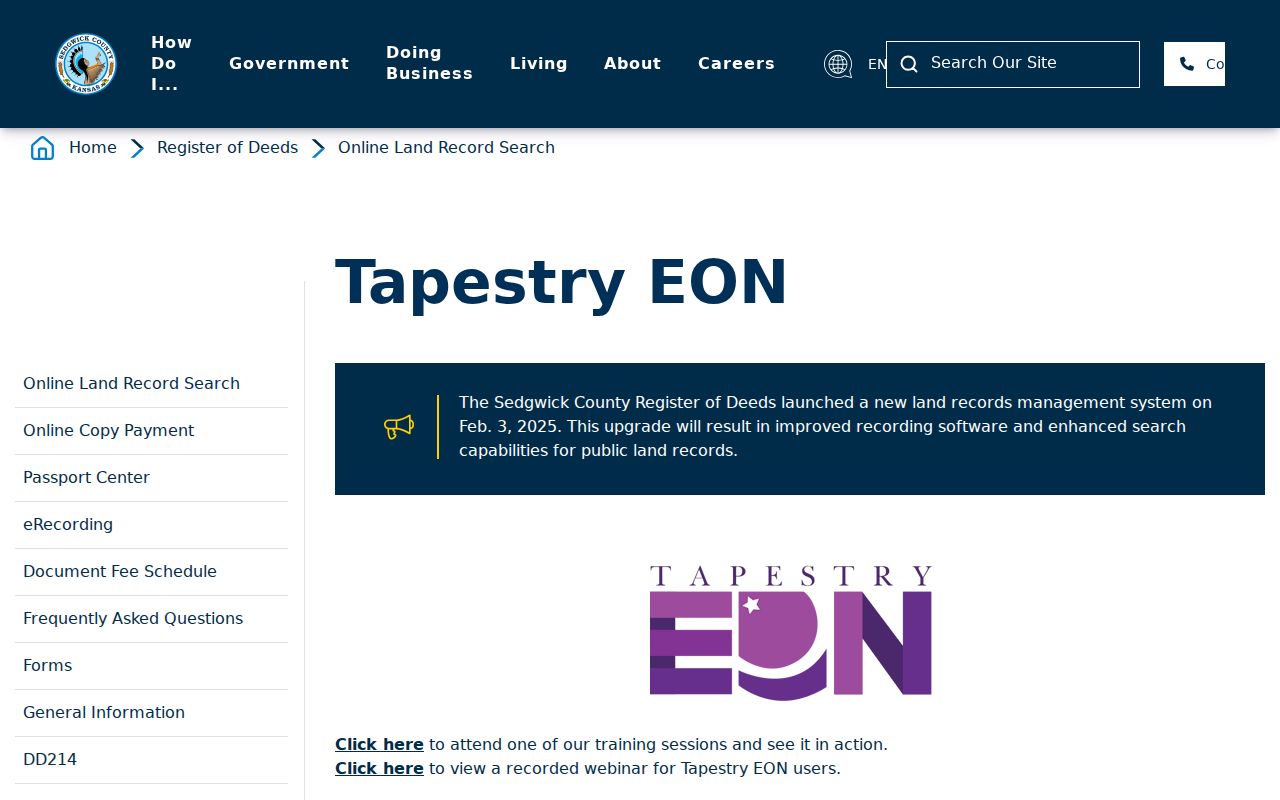
The service broadens remote access, but its result still needs a legal-description match.
Bridge Derby Gaps with Transfer Books
For transfer information before 1992, consult the Sedgwick County Clerk's Historical Transfer Books, then obtain the actual recorded instrument from the Register of Deeds. A transfer book is a finding aid, not a substitute for the deed image. Keep the first and last transfer dates, deed number, and exact land description together.
The Register of Deeds FAQ explains the older-index route and office copy options.
This guidance marks the point where a remote Derby search should move to books, microfilm, or staff assistance.
Derby Address Names Change
A street number can fail before the property trail does. Derby retains permanent Street Name Files, plat maps, subdivision files, surveys, vacation petitions, and related infrastructure records. No public line-by-line address-change log was found, so request the relevant file and date range through the City Clerk or GIS and Engineering.
The earlier El Paso name is another search key. The town was platted under that name in 1871, the depot used Derby by 1880, and the official city name changed in 1956. The 1902 county directory also paired Derby postal entries with Rockford, Salem, and Gypsum township labels. Save the exact place label used by each source.
Check Derby Maps Without Assuming Coverage
The Kansas Historical Society Sanborn guide describes fire-insurance maps that show streets, structures, water features, and hydrants. Kansas coverage spans 1883 to 1954, with some later revisions. No official Derby edition was located in the KSHS or Library of Congress indexes reviewed, though Wichita coverage exists.
Consult the KSHS map guide shown below, then ask KSHS or Wichita Public Library to check the city list and microfilm rolls for the target year.
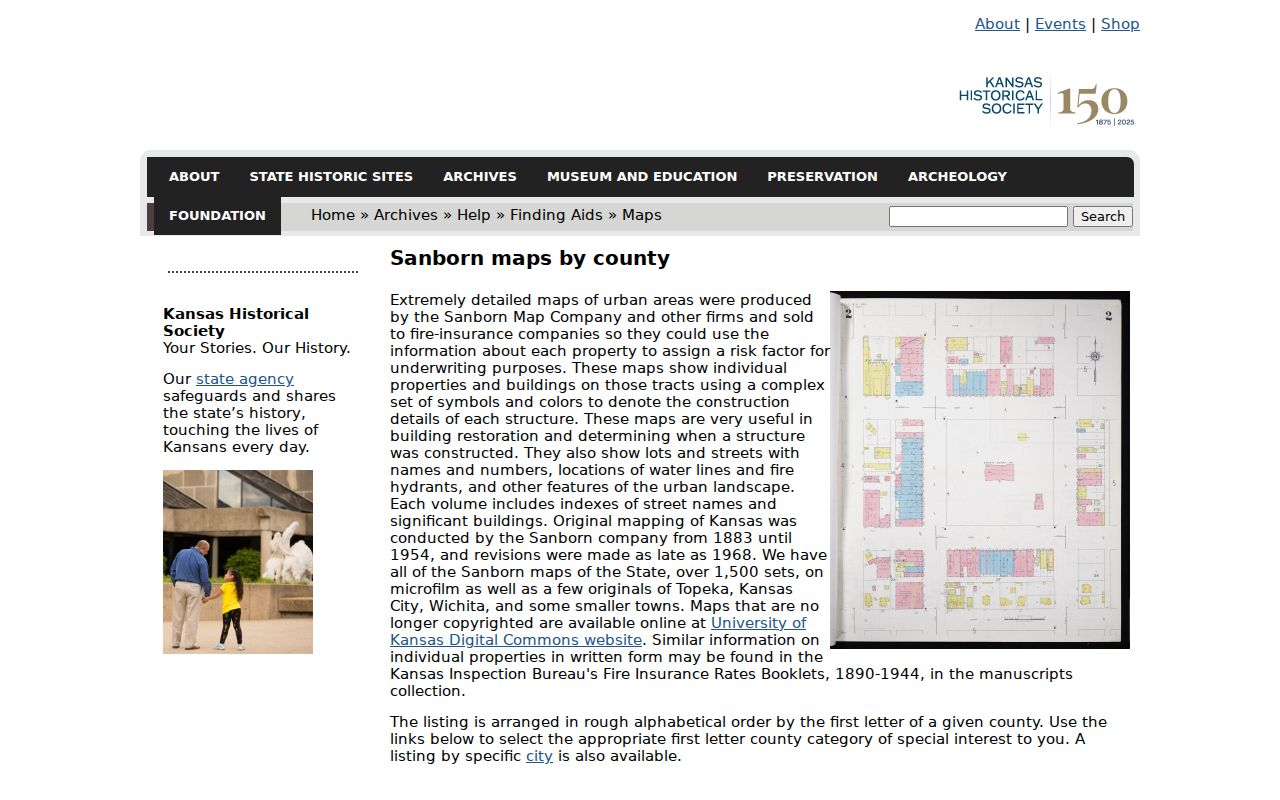
A map absence in an online index should be recorded as a gap, not as proof that no useful sheet exists.
Cite Derby Previous Resident Links
For every step backward, record the instrument date, document number, party roles, legal-description match, and the source image or book page. Keep an owner column apart from an occupant column. A directory can support occupancy for one year, while a deed supports a recorded land interest on its date. If either source uses El Paso, a township, or an old street form, copy that wording exactly and explain the proposed Derby match.
Match Derby Past Households by Year
Owners are only one part of the history. A criss-cross directory may connect an address to a surname in its publication year, while an alphabetical entry can confirm spelling. The Derby city directory collections include county suburban volumes from 1957 to 1995 and telephone or criss-cross sources from the 1930s forward.
Use a simple flow: directory address and year, then alphabetical entry, then the nearest available census, deed, parcel record, newspaper, photograph, or map. Census records group a household at an enumeration date, but address forms and district geography can shift. Cite the page and year, and never carry a household name into a year the source does not cover.
The Derby Public Library holds yearbooks, newspapers on microfilm, local references, and the Derby History Archive. Wichita Public Library adds directories, telephone books, maps, atlases, photographs, and Sanborn microfilm. Obituaries, cemetery references, and probate records can explain when a person left the trail, but a same-name match still needs corroboration.
Lawful use. Research Derby previous residents for house history, genealogy, estate work, or personal curiosity. Never use old or current address data to harass or track a living person.